

Debunking the Hollow Earth Myth
A Scientific Perspective

On Quora.com, I once addressed the question: “Most top scientists of today have accepted the hollow Earth hypothesis. This bothers you, doesn't it?”
I’m not bothered by the hollow Earth hypothesis itself, but I am bothered by the fact that some people still believe in it and spread misinformation. Reputable scientists have never accepted it, and that’s the real issue.
Edmond Halley, the astronomer who famously predicted the return of Halley's Comet, proposed the idea of a hollow Earth in 1692—long before we understood the existence of germs and how they cause diseases. Today, scientific understanding has expanded in fields like microbiology, geology, and physics, and Halley’s ideas about the Earth’s interior are recognized as speculative, with no evidence to support them.
The claim that "most top scientists of today have accepted the hollow Earth hypothesis" is simply false. No credible scientist supports it today. It’s a pseudoscientific idea that has been debunked for centuries.
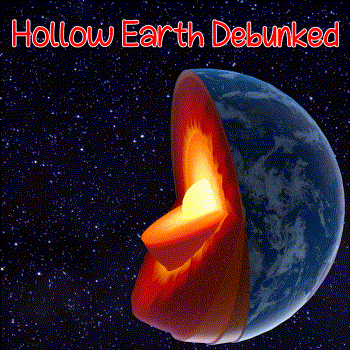
We know the Earth’s internal structure with remarkable accuracy thanks to tools like seismometers and gravimeters. Seismometers measure how sound waves travel through the Earth, and gravimeters detect variations in the Earth's gravitational field. These tools provide a detailed, evidence-based picture of the Earth's inner layers—from the solid crust to the molten core—showing that the Earth is not hollow.
Moreover, our understanding of planet formation doesn’t allow for the creation of hollow planets or moons. The way planets evolve from planetesimals makes the formation of a hollow core impossible.
Pseudoscience is characterized by unproven, unfalsifiable claims and resistance to rigorous testing. The hollow Earth theory, like other debunked ideas, relies on confirmation bias rather than credible scientific evidence. These theories persist despite being disproven by solid research.
The Earth’s density is far too high for it to be hollow. Seismic waves travel through different materials—such as molten rock and metals—at different speeds. These measurements give us a clear picture of the Earth’s interior. If the Earth were hollow, these waves would behave differently. Instead, they show a solid core surrounded by a liquid outer core, with a solid mantle and crust.
Despite overwhelming evidence, the hollow Earth theory persists among conspiracy theorists. It may appear in science fiction and pop culture, but it has no basis in real science.
To answer the question directly: No, the idea that top scientists support the hollow Earth hypothesis doesn't bother me because it simply isn’t true. It’s a myth. The science is clear: the Earth is a solid, oblate spheroid with a molten iron core that generates our magnetic field—an essential feature for navigation.