

The Autocrat’s Playbook
Fear, Revenge, and the Erosion of Freedom

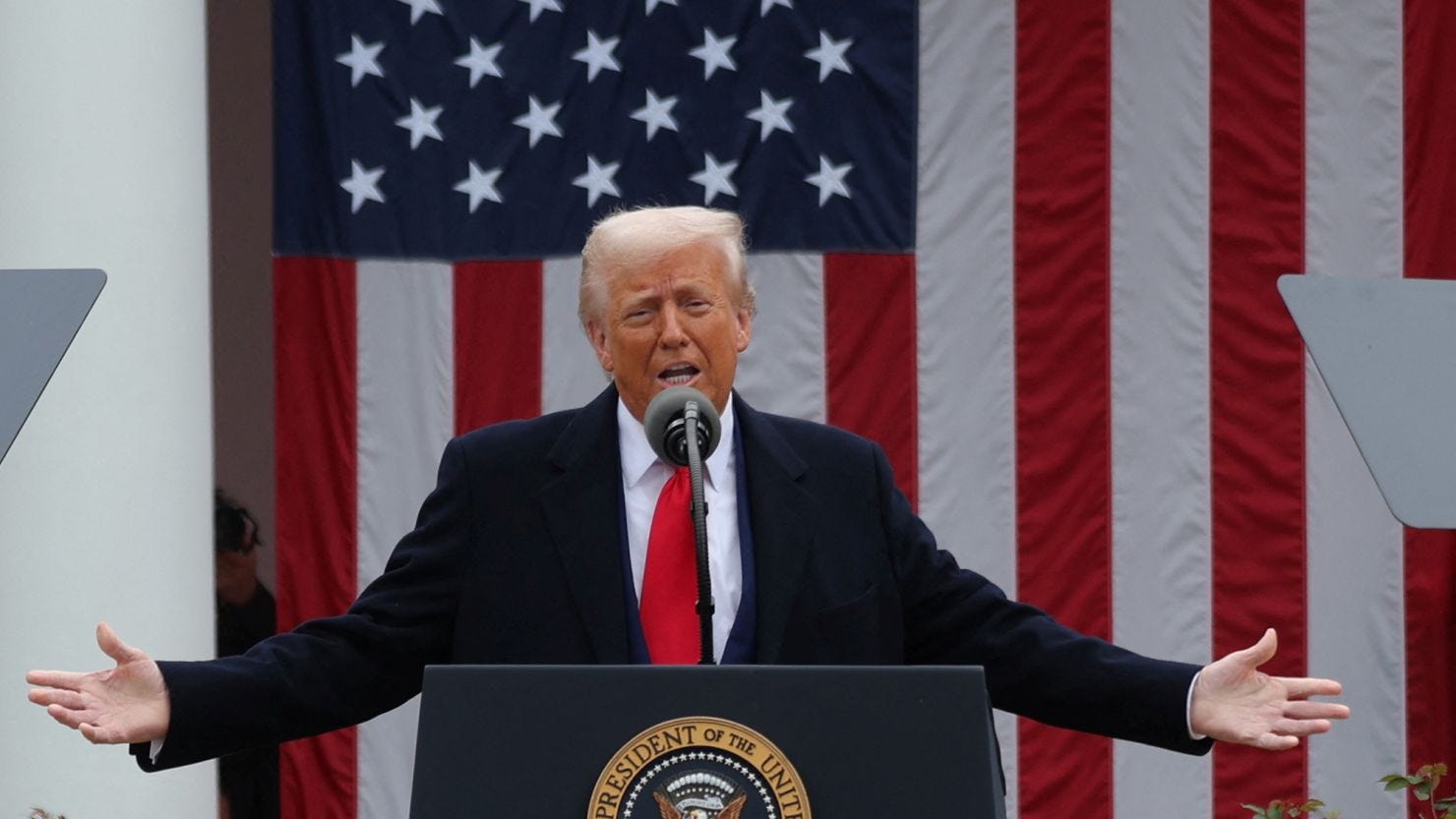
U.S. President Donald Trump delivers remarks on tariffs in the Rose Garden at the White House in Washington, D.C., U.S., April 2, 2025. Carlos Barria/Reuters
Lately, I’ve been acting like Trump—up at all hours, firing off thoughts on social media. Shame on me. It’s definitely bedtime.
But I stayed up for a reason.
This article has been gnawing at me for a long time. If it makes you uncomfortable, I understand. But I can only speak what I believe to be true.
History is clear about what happens when authoritarian regimes take power: they come for property, for rights, and eventually, for people. The communists in Russia didn’t stop at land and possessions. They ruled through fear. They demanded absolute loyalty. They erased individuality, critical thinking, and dissent.
Fear is always the first tool in the autocrat’s toolbox. A frightened population is an easier one to control.
And I see that same playbook being dusted off today.
The MAGA movement has been thoroughly conned by a man who seems to be following that script step by step—with a nod and a wink from Vladimir Putin, whose version of leadership looks nothing like the American ideals MAGA followers claim to support.
In late June 2024, presidential candidate Donald Trump’s personal jet—“Trump Force One”—was photographed parked side by side with a Russian government aircraft at Dulles International Airport. This occurred shortly after Trump had been convicted on 34 felony counts by a jury of twelve Americans—jurors his own legal team helped select. The verdict was impartial, lawful, and unanimous.
So here he was: a convicted felon, still running for president, deeply in debt, and arguably desperate for resources. And then—almost like clockwork—Vladimir Putin’s plane touched down on U.S. soil and taxied into position right next to Trump’s.
It was a surreal and deeply unsettling image, captured by freelance journalist Andrew Leyden in a secured area of the airport known as Apron W. While no official meeting was recorded or acknowledged, the symbolism was impossible to ignore: the former president of the United States, now a convicted felon, parked side by side with the leader of a hostile foreign power.
Coincidence? Maybe. But it certainly doesn’t inspire confidence. You can even watch the footage here:
According to flight data, the Russian plane arrived first—at 9:55 a.m. on June 27. Trump’s plane landed later that night, just past midnight. For about 14 hours, the two aircraft sat side by side. During that time, a military jet from the UAE showed up too. So now we’ve got three powerful aircraft from three very different regimes parked together in Washington, D.C.
Putin is smart. Trump is not. It’s not hard to imagine that Trump—the guy with the orange makeup, the rambling speech patterns, and the paper-thin ego—is being manipulated by someone with far more strategic sense. And it’s not hard to see what Vladimir Putin stands to gain: a weakened America. A divided West. A former superpower led by a man who praises dictators and thinks democracy is for suckers.
Donald Trump faced significant financial trouble due to a combination of massive legal judgments and looming business debts. In early 2024, he was ordered to pay over half a billion dollars in two civil cases: the E. Jean Carroll defamation and sexual abuse lawsuit, and the New York civil business fraud case. He also owed around $330 million to Deutsche Bank, with major payments coming due in 2023 and 2024. These mounting financial pressures created an urgent need for cash, putting him at risk of losing much of what he owned. And he additionally had a very real chance of going to prison in several states as well as Federal prison.
This was a desperate man who believed he was going to lose the election and had already prepared a misinformation campaign to explain his loss by blaming cheating by Democrats. When he won, those accusations didn’t go away. Instead, they were weaponized—used systematically to make it increasingly difficult for people to vote, while he publicly called for the conviction and imprisonment of those involved in his prior court cases, including ones that had not yet concluded because he became president. He pardoned hundreds of men and women who had violently attacked the Capitol, killed police officers, maimed others, erected a gallows to hang the Vice President of the United States—and then shamelessly described it all as a “love festival.” As if to mock science itself, he appointed as Surgeon General someone who openly rejects modern medicine, claims he once had a worm in his brain, and speaks in a strange, broken voice as if gurgling through his own delusions. Don’t get me started with the Secretary of State and the Supreme Court.
We already know what autocrats do: they expand territory, centralize power, and crush dissent. Trump has already floated the idea of invading Panama, Canada, and Greenland—as if the world were just a Monopoly board and he’s the banker.
And none of this should surprise us. We were warned. Experts of every kind—scholars, journalists, farmers, even billionaires (well, maybe not Musk)—sounded the alarm. They said Trump would try to dismantle the Department of Education. They said he’d try to purge the country of immigrants. They said he’d weaponize the government against his enemies.
And here we are, watching it unfold.
Trump displays every sign of being a malignant narcissist—no empathy, no remorse, no loyalty to anyone but himself. Even his most loyal followers are just pawns. They cheer while he signs policies that will hurt them first.
Under Trump, the foundation of the United States has been gutted. The damage may be permanent. In many ways, the America we once knew is already gone.
Autocrats don’t just consolidate power—they crave revenge. Once they’ve got it, they go after everyone who stood in their way: political opponents, judges, jurors, journalists. Trump has already vowed to imprison those who held him accountable in court. He’s promised retribution. That’s not hyperbole—that’s his campaign platform.
In functioning democracies, the press is a safeguard. In autocracies, it's the enemy. That’s why Trump began calling the media “Fake News” almost immediately after taking office. The spark? A simple dispute over crowd size at his 2017 inauguration. The press reported the turnout was modest. Trump insisted it was the biggest in history. When reality didn’t match his ego, he didn’t just deny the facts—he attacked the people reporting them.
From that moment on, “Fake News” became his favorite weapon. Any coverage he didn’t like—polls, fact-checks, investigations, even satire—was labeled fake. It didn’t matter how accurate it was. The goal wasn’t to correct misinformation—it was to destroy public trust in journalism altogether. If the people can’t tell what’s true, they’ll believe the loudest voice. And that voice, of course, is his.
So what’s left to protect us?
The Constitution—maybe. And so far, the Supreme Court’s commitment to free speech has held. But even that isn’t invincible. It only works as long as people care. When citizens stop paying attention—or worse, start believing the lies—freedom begins to rot.
Maybe we can’t stop what’s coming—but we can slow it down. We can expose it. We can push back. Yet in the end, entropy always wins. According to the second law of thermodynamics, all order inevitably decays into chaos. With that broad philosophical brush, we can frame the horrifying and inhumane actions already taken by Trump and his administration in just the first hundred days of his return to office as part of that same grim trajectory—where systems unravel, and cruelty replaces principle.
Whether it’s the political situation plunging the world into sudden peril, the changing climate wiping out entire towns through droughts, floods, hurricanes, and tornadoes, or simply the unrelenting march of entropy—the law of physics that says the universe moves from order to disorder over vast geologic timescales—one thing has become heartbreakingly clear: we are all fucked.
I just never imagined it would happen in my lifetime.